English
 KR
KR  IA
IA  JP
JP 

Ovarian Cyst
A solid or fluid-filled sac or pocket (cyst) within or on the surface of an ovary.
Women usually have two ovaries on each side of the uterus. Eggs (ova), which develop and mature in the ovaries, are released in monthly cycles during the childbearing years.
Many women have ovarian cysts at some point in time. Most ovarian cysts present little or no discomfort and are harmless. The majority disappears without treatment within a few months.
Find us easily and plan your visit with confidence. View our location for clear directions and a seamless dining or consultation experience.
get in touch today!
Contact Us
akshayafertilityslm@gmail.com
Work Time Information
Open 24 Hours
Causes
Most ovarian cysts develop as a result of the menstrual cycle (functional cysts). Other types of cysts are much less common.
Symptoms
Most cysts don’t cause symptoms and go away on their own. However, a large ovarian cyst can cause:
Pelvic pain — a dull or sharp ache in the lower abdomen on the side of the cyst
Fullness or heaviness in your abdomen
Bloating
When to see a doctor
Seek immediate medical attention for:
Sudden, severe abdominal or pelvic pain
Pain with fever or vomiting
Diagnosis
A cyst on the ovary can be found during a pelvic exam. Depending on its size and whether it’s fluid-filled, solid, or mixed, doctors likely will recommend tests to determine its type and whether it needs to be treated. Possible tests include:
Pregnancy Test
Pelvic Ultrasound
Laparoscopy
CA 125 blood test
TREATMENT
Treatment depends on the age, the type and size of the cyst, and other symptoms. The doctor might suggest:
Wait and watch:
In many cases, one can wait and be re-examined to see if the cyst goes away within a few months. Regardless of the age, this is typically an option if one has no symptoms and an ultrasound shows the patient has a simple, small, fluid-filled cyst.The doctor will likely recommend that to get follow-up pelvic ultrasounds at intervals to see if the cyst changes in size.
Medication:
A doctor might recommend hormonal contraceptives, such as birth control pills, to keep ovarian cysts from recurring. However, birth control pills won’t shrink an existing cyst.Surgery:
Sometimes the doctor might suggest removing a large cyst, doesn’t look like a functional cyst, is growing, continues through two or three menstrual cycles, or causes pain.Some cysts can be removed without removing the ovary (ovarian cystectomy). In some cases, the doctor might suggest removing the affected ovary and leaving the other intact (oophorectomy).
If a cystic mass is cancerous, need to have your uterus, ovaries and fallopian tubes removed (total hysterectomy) and possibly chemotherapy or radiation. The doctor is also likely to recommend surgery when an ovarian cyst develops after menopause.
A link between ovarian cysts and infertility
Ovarian cysts that can affect your fertility include:
Endometriomas:
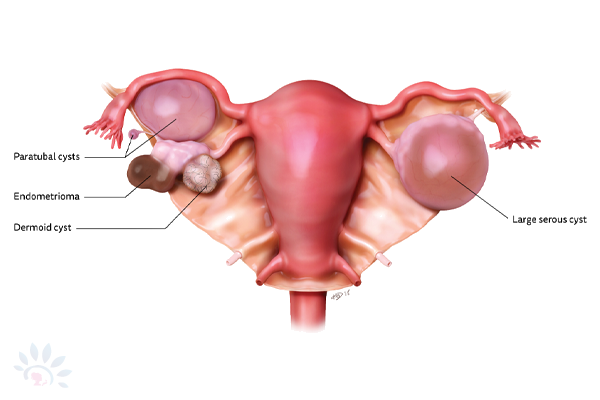
Endometriomas are cysts caused by endometriosis, a condition in which the tissue normally lining the uterus (endometrium) grows outside the uterus. These ovarian cysts may be associated with fertility problems.Ovarian cysts resulting from polycystic ovary syndrome:
But
Polycystic ovary syndrome (PCOS) is a condition marked by many small cysts on your ovaries, irregular periods, and high levels of certain hormones. is associated with irregular ovulation, which may contribute to problems with fertility in some women.- Functional cysts.
- Cystadenomas.
- Dermoid cysts.
Are the cysts that don’t cause fertility problems.